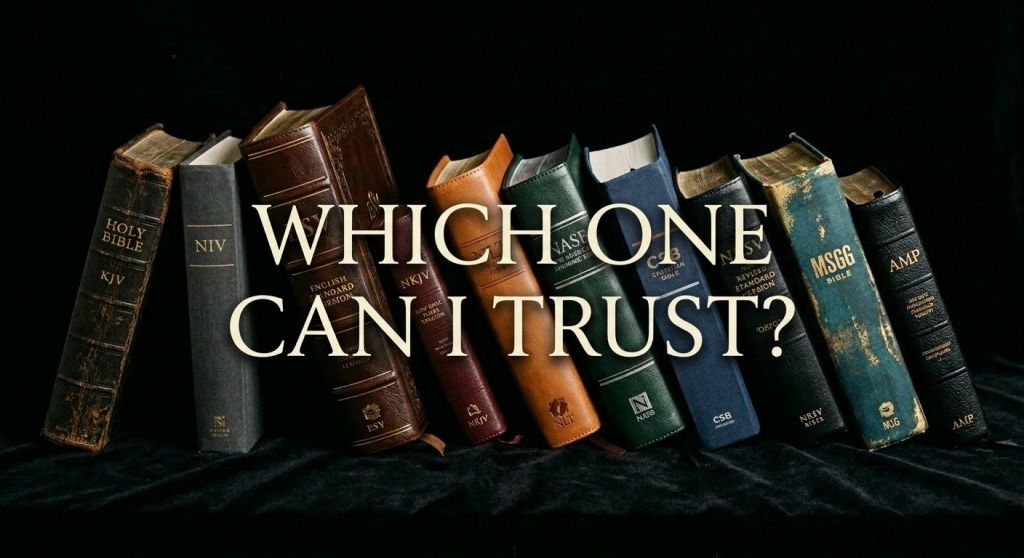
DID THEY ALTER THE MODERN BIBLE IN NEW TRANSLATIONS…
No, modern translations like the NIV, ESV, or NASB did not alter the original to fit modern views. Take for example the long toothed claim that they erased the deity of Jesus in the NIV. I myself was caught in this view. This claim that modern Bibles attempt to strip or downplay Christ’s divinity comes primarily from strict “King James Only” (KJO) movements and stems from a misunderstanding of manuscript history.
Here is a breakdown of why this controversy exists and what is actually happening behind the translations.
- Where the Accusation Comes From
KJV-Only proponents often point to specific verses where modern translations use different wording or omit certain phrasing found in the King James Version, claiming these edits intentionally “attack” Jesus’s deity.
Common examples include:
1 Timothy 3:16
KJV: “God was manifest in the flesh…”
NIV / ESV: “He was revealed in a body…”
1 John 5:7–8 (The Johannine Comma)
KJV: Includes explicit phrasing about three that bear record in heaven (“the Father, the Word, and the Holy Ghost: and these three are one”).
Modern Versions: Omit that specific clause, jumping straight to the three earthly witnesses (“the Spirit, the water and the blood”).
Daniel 3:25
KJV: “…the form of the fourth is like the Son of God.”
NIV: “…and the fourth looks like a son of the gods.”
To someone reading only the English text without context, it can look like words were removed to weaken the statement that Jesus is God.
- Why the Differences Actually Exist
The changes are not due to a theological conspiracy; they are the result of better manuscript availability and textual scholarship.
Oldest Manuscripts vs. Later Copies
The KJV Source (Textus Receptus): Translated in 1611, the KJV relied primarily on late medieval Greek manuscripts (mostly from the 12th to 15th centuries). Over centuries of copying by hand, minor scribal additions, commentary notes, or expanded phrasing had naturally crept into the manuscript tradition.
Modern Translations: Modern versions utilize thousands of earlier manuscripts discovered over the past 200 years (such as the Codex Sinaiticus and Codex Vaticanus), dating back to the 2nd, 3rd, and 4th centuries. Modern scholars aim to translate what the original biblical authors wrote, rather than later scribal expansions.
Examples Explained:
1 Timothy 3:16: In the earliest Greek manuscripts, the relative pronoun \Theta\Sigma (an abbreviation for Theos / “God”) was actually \mathrm{O}\Sigma (hos / “He” or “Who”). A later scribe likely accidentally (or intentionally) added a small horizontal stroke inside the Greek letter omicron, turning “He who” into “God.” Modern translators stick to the oldest manuscript reading (“He appeared…”).
1 John 5:7: The phrase explicitly defining the Trinity was not present in any Greek manuscript before the 14th century—it was originally a Latin scribal margin note added centuries later.
- Modern Bibles Still Strong Affirmatively Teach the Deity of Jesus
Far from removing the deity of Christ, modern translations actually render other passages in ways that affirm Jesus’s divinity even more clearly than the KJV does, thanks to advances in Greek grammar rules (like the Granville Sharp Rule).
Passage:
King James Version (KJV)
Titus 2:13
“…the glorious appearing of the great God and our Saviour Jesus Christ” (Sounds like two separate beings)
New International Version (NIV)
“…the appearing of the glory of our great God and Savior, Jesus Christ” (Explicitly identifies Jesus as God)
King James Version (KJV)
2 Peter 1:1
“…through the righteousness of God and our Saviour Jesus Christ”
New International Version (NIV)
“…through the righteousness of our God and Savior Jesus Christ”
John 1:18
King James Version (KJV)
“…the only begotten Son…”
New International Version (NIV)
“…the only begotten God…” (Supported by the oldest Greek manuscripts)
John 8:58
King James Version (KJV)
“…Before Abraham was born, I am!”
New International Version (NIV)
“…Before Abraham was born, I am!” (Maintained across all versions)
Summary
The claim that modern versions erase the deity of Christ relies on a lack of familiarity with textual criticism.
Translators of modern Bibles are not removing doctrine; they are comparing thousands of ancient manuscripts to remove later scribal additions and accurately translate the original text. The deity of Jesus remains a foundational, explicit teaching across all major Christian translations.
I addition, many of the complex words we do understand today, did not have the same meaning 400 years ago, and this also leads to misinterpretation by people who sincerely are trying to follow the KJV, unaware of these many issues.
God has protected His own word in many languages, who do not have a KJV simply because they do not speak English. And even English itself has transformed since the turn of the prior millennium.
Therefore do not base your truth and teachings on a translation, base it on the unity of all translations, which are formed from the original languages of Hebrew, Aramaic, and Greek; the languages the original authors wrote in.


